Fan essay / Still rolling
Why Airborne Still Has a Cult Following
Because it gave us Mitchell Goosen, Cincinnati hills, Team Rollerblade velocity, a future-star cast, and the irresistible idea that our own streets might be hiding a Devil’s Backbone.
Two frames underline the essay’s central argument: character chemistry and skating craft are inseparable from the film’s afterlife.
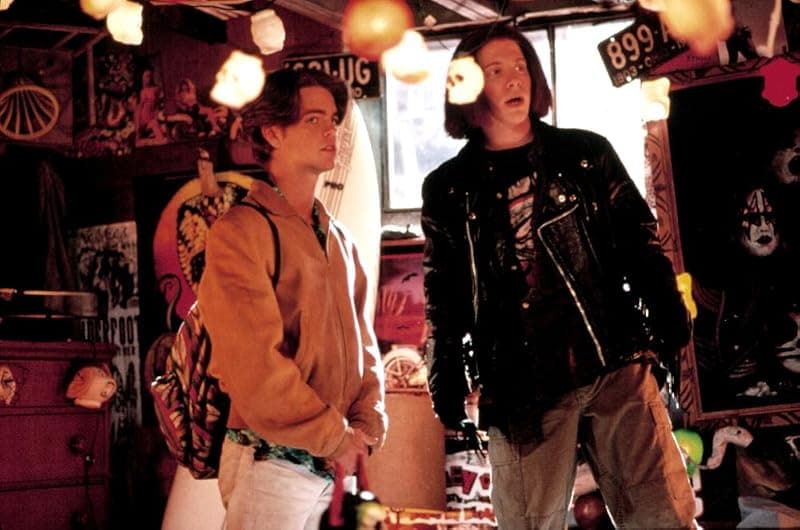
Shane McDermott as Mitchell Goosen with Seth Green as Wiley Messner—a pairing that anchors the film’s fish-out-of-water comedy.
Film frame via IMDb · Airborne (1993) © applicable rights holder ↗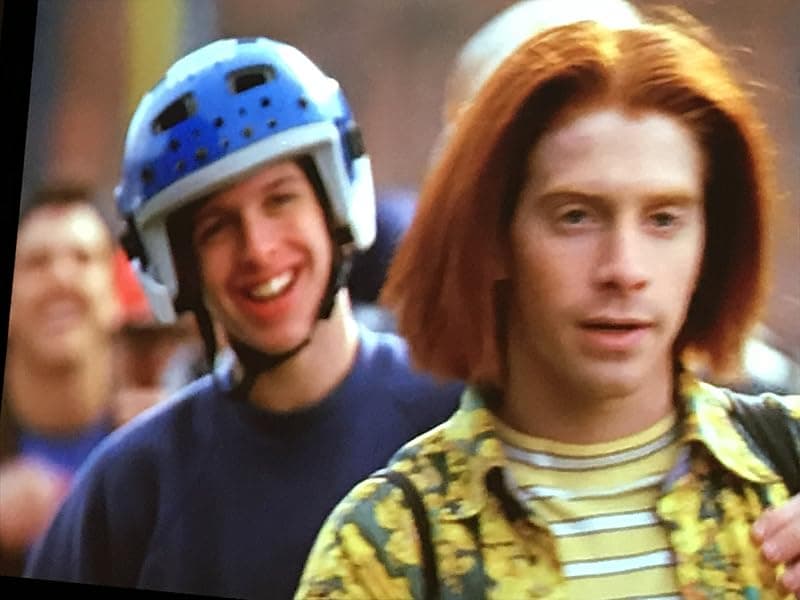
The skating ensemble in motion. AFI documents Team Rollerblade’s work choreographing sequences, performing stunts, and training the actors.
Film frame via IMDb · Airborne (1993) © applicable rights holder ↗Airborne has lasted because it knows exactly what it loves—and never once plays that love cool.
Mitchell Goosen was the whole deal
Some movie heroes arrive with a grand destiny. Mitchell arrives with a surfboard, a pair of blades, a very particular philosophy, and the unshakable belief that Cincinnati winter cannot permanently ruin his vibe. Shane McDermott plays him with just enough serenity to make the confidence magnetic instead of smug. Mitchell is cool, but he is also kind. He would rather glide around conflict than punch through it—until the people he cares about give him something worth standing up for. For a generation of young viewers, that combination was practically a blueprint.
California meets the Queen City
The fish-out-of-water setup gives Airborne its spark. Mitchell’s Southern California ease lands in a city of snow, steep streets, school rivalries, and hockey pads. The movie never chooses between those worlds; it lets surf energy roll straight into Cincinnati asphalt. That collision is why the setting matters so much. Krohn Conservatory, Pompilio’s, Western Hills, the riverfront, the airport, and all those hills give the movie texture no anonymous backlot could have supplied.
It is gloriously, specifically Airborne
Rollerblading. Surfing. Romance. Hockey. Comedy. Teen conflict. A shark named Pepe. Bean burritos. Airborne throws all of it together with complete sincerity, and that specificity is a superpower. The movie is quotable because it has its own language; memorable because it is never embarrassed by its enthusiasms. Plenty of early-1990s movies have bright clothes and a loud soundtrack. Only one feels quite like this.
A cast with the right chemistry
McDermott is the center, but the movie works because everyone pulls on his calm in a different direction. Seth Green gives Wiley anxious comic energy. Brittney Powell makes Nikki more than a prize at the end of a rivalry. Chris Conrad and Jacob Vargas bring the friction, while Alanna Ubach, Edie McClurg, Patrick O’Brien, Chris Edwards, and the rest of the ensemble make the world feel crowded and alive. Then there is Jack Black, already impossible to miss. Watching Green and Black before their later fame is part of the fun, but Airborne is not merely a footnote in their careers—the chemistry belongs to this movie.
The skating still has velocity
The skating is not decoration pasted onto a teen comedy. Team Rollerblade spent twelve days choreographing sequences, performing stunts, and training actors. Chris Edwards doubled Mitchell’s skating, and the credits name a full roster of professionals. That craft is all over the screen: rail grinds, stairs, parking-lot hockey, riverfront pavement, and the delirious geography of the Devil’s Backbone. The final race may not connect as a real route, but as pure screen movement it absolutely flies.
Shane McDermott and the beautiful mystery of one perfect role
It is hard to imagine anyone else as Mitchell. McDermott later moved away from day-to-day Hollywood life, building a career and family outside the industry while continuing to speak warmly about Airborne. That distance adds to the mystique. Mitchell never became one entry in a long parade of similar leading roles; he remains suspended in this one strange, sincere movie—forever arriving from California, forever lacing up, forever heading downhill.
The movie you saw young and never quite left
The original impulse behind this archive came from seeing Airborne at ten years old in Southern California and recognizing an older, cooler version of a possible self. The immediate response was obvious: convince the parents to buy Rollerblades, copy Mitchell’s style, and go looking for a hometown Devil’s Backbone. That story is personal, but the feeling is widely recognizable. Airborne did not need to be the biggest movie of 1993. It only needed to reach the right kid at the right moment—and make the world outside look like it had more hills, more speed, and more possibility than it did two hours earlier.
Read further
Sources
Primary records, interviews, established references, and clearly labeled specialist leads.
- AFI Catalog: Airborne ↗American Film Institute · Accessed 2026-09-11
Archival catalog record based in part on production notes and screen credits; used for cast, production, music, skating, locations, and release details.
- Revisiting a 2013 Interview with Airborne Star Shane McDermott ↗Cincinnati CityBeat · Accessed 2026-09-11
Direct interview: McDermott discusses filming at the airport, Pompilio’s, Krohn Conservatory, skating preparation, and stunt participation.
- Airborne (1993) filming locations ↗Film Oblivion · Accessed 2026-09-11
Evidence that specialist retrospective documentation of the film continued decades after release; not used as proof of production claims beyond its comparisons.
- HDTGM: A Conversation With Shane McDermott, Star of Airborne ↗Slashfilm · Accessed 2026-09-12
Direct interview covering McDermott’s casting, performance, production memories, and life away from day-to-day Hollywood work.