Mitchell Goosen / Airborne’s laid-back center
Shane
McDermott
The New York teenager who could already skate, carried his Rollerblades into the audition, and made a California surfer feel completely at home on Cincinnati’s steepest streets.
Mitchell Goosen does not conquer Cincinnati so much as glide into it, absorb the collision, and quietly persuade almost everyone else to loosen up.
The character
Playing Mitchell Goosen
Mitchell arrives from Southern California with a surfboard, inline skates, sun-lightened hair, and absolutely no preparation for an Ohio winter. He is an outsider in every obvious way: dropped into his aunt and uncle’s home, paired with an anxious cousin, placed inside a school culture he does not understand, and dressed as if snow were a rumor. Yet the joke is rarely that Mitchell is foolish. The movie lets his calm become a genuine strength.
That is the essential pleasure of McDermott’s performance. Mitchell has confidence without the usual macho insistence that everybody notice it. He would rather deflect a confrontation, say something disarmingly sincere, or skate away than establish himself by force. His California vocabulary and surfer philosophy are broad enough to be funny, but McDermott never plays them with a wink. He believes in Mitchell’s ease, which keeps the character from becoming a parody in a wardrobe of loose shirts and impossible hair.
Mitchell is laid-back, not passive. He watches, adjusts, and eventually chooses when to push back. His skating gives that attitude a physical form: balance instead of brute force, momentum instead of posturing. Even as the plot pulls him toward hockey fights, romance, friendship, and the Devil’s Backbone, he remains recognizably the same kid who stepped off the plane. He wins people over more often than he defeats them. That is a small distinction, but it is the reason he remains so easy to root for.
The audition
A New York skater meets a California kid
Before Airborne, McDermott had worked as a Ford model and moved into commercials as he grew out of children’s print work. Acting followed: an Ethan Allen spot, Stove Top Stuffing, and then the youth television series Swans Crossing, which he remembered shooting at a furious pace—65 episodes in three months. That production gave him real television experience, but Mitchell Goosen would be his first starring role in a feature film.
The skating hook was not an invention added after he was cast. As McDermott told Slashfilm, Rollerblades were how he sometimes traveled to auditions around New York. He skated the city during summer, carried his blades with him, and believes he may even have rolled to the Airborne audition itself. After reading for the role, he went back out to skate. The part already joined two things he understood: being a working teenage actor and moving through a city on eight wheels.
The contrast was useful. Mitchell was written as a relaxed California surfer; McDermott was a New York kid who looked the part but approached it from the opposite coast. He remembered the audition simply clicking in front of director Rob Bowman. The character, the summer tan, and those Rollerblades all seemed to land in the right place. Then came the startling news that he had booked the lead. Television had taught him how a set worked. Nothing had prepared him for being sixteen and carrying a feature.
The performance
Why the role works
McDermott’s great choice is sincerity. A louder performance might have made Mitchell’s surfer language exhausting, or turned his refusal to fight into smug superiority. Instead, the calm feels instinctive. Mitchell does not enter each room determined to prove he is cooler than everyone in it. He often looks as if he is figuring out the room in real time, then deciding that being himself will probably work.
That outsider quality allows Cincinnati to feel strange without making Cincinnati itself the punch line. The cold, brick schools, hockey culture, and steep streets are real obstacles, but the city gradually becomes an extension of Mitchell’s identity rather than something he needs to escape. McDermott lets the discomfort show just enough. He later said Bowman’s relaxed direction created an environment where he could settle into the character naturally; even the actor’s uncertainty on his first feature could feed Mitchell’s fish-out-of-water feeling.
The composure also sharpens every relationship around him. Wiley’s nervous comic velocity gets funnier beside Mitchell’s steady rhythm. Nikki meets somebody confident enough to speak plainly but gentle enough to listen. The rivals can provoke him, but they do not define him. And because McDermott can genuinely move on skates, the physical confidence never feels disconnected from the personality. Mitchell’s cool is not a speech the movie gives him. It is the way he occupies space.
Wheels down
Shane could actually skate
For fans, this matters: the person playing Mitchell did not look comfortable on Rollerblades only because of careful editing. McDermott had spent his teenage summers skating through New York traffic, sometimes even grabbing taxis for extra speed. He told CityBeat that those streets taught him enough to make Mitchell look authentic. You can see it in the smaller connective moments—the stance, the push, the ease of rolling into a scene—where a double would have broken the performance’s flow.
The largest tricks belonged to specialists. Pat Parnell led the professional skate team, and Chris Edwards served as McDermott’s skating double while also playing Walt. McDermott remembered Edwards as someone who seemed exempt from gravity. The production record credits Team Rollerblade with choreography, stunt performance, and actor training, work explored in the archive’s skating and stunts guide.
That division of labor does not mean McDermott stayed safely out of the action. Once the production reached the skating-heavy material, he relished getting onto the hills with the professionals and doing what he could to make the movement convincing. He also took his share of punishment. By the end of filming, he had earned the crew’s joking award for “most carnage,” with most of the damage accumulated during the Devil’s Backbone. Mitchell’s unruffled glide was built on a performer willing to hit the pavement.
First day / First feature
Arriving in Cincinnati
McDermott’s own introduction to Cincinnati uncannily mirrored Mitchell’s. Airborne was his first visit to the city, and he arrived before much of the cast. With time available and snow beginning to fall, a smaller unit took him to the airport to film Mitchell’s entrance. Production had access to an otherwise empty parked 737 and the working airport area around it. For a teenager who had never starred in a feature, the scale of it was astonishing.
He was dressed for California—jeans, Vans, and a light jacket—while standing in the snow near the aircraft, exactly the mismatch the scene needed. McDermott’s remembered reaction was wonderfully direct: “This is so cool.” The shoot made the machinery of a feature film suddenly tangible. There was a plane, an airport, a crew, and his character’s surfboard coming off into the cold.
The finished sequence remained one of his favorite memories and later opened the trailer. It works because the production spectacle and the character beat are the same thing: Mitchell and McDermott are both taking in a much bigger, colder world than expected. The archive’s CVG location file follows that arrival from the film frame to the documented airport setting.
Queen City production
Cincinnati memories
The schedule did not leave McDermott much time to explore like a tourist. Mitchell appears in nearly every part of the story, which meant early calls, long days, and a film crew almost constantly nearby. Even so, certain places cut through the blur. He singled out Pompilio’s, the Cincinnati skyline, and Krohn Conservatory when CityBeat asked what he remembered most clearly.
The date-night material seems to have carried a special glow. McDermott recalled Cincinnati arranging to illuminate the downtown skyline for the production, a gesture that impressed him then and continued to shape the way he spoke about the city years later. His verdict—“Cincinnati is the best”—is brief, but it explains why his memories feel warmer than a list of shooting locations.
Those recollections also explain why the city is inseparable from Mitchell. Pompilio’s gives the double date a specific neighborhood texture. Krohn turns a romantic outing into something lush and strange. The skyline and hills make the movie feel bigger than its school-story framework. Readers can follow those memories through the archive’s scene-by-scene filming guide, where Cincinnati and Northern Kentucky emerge as characters rather than background.
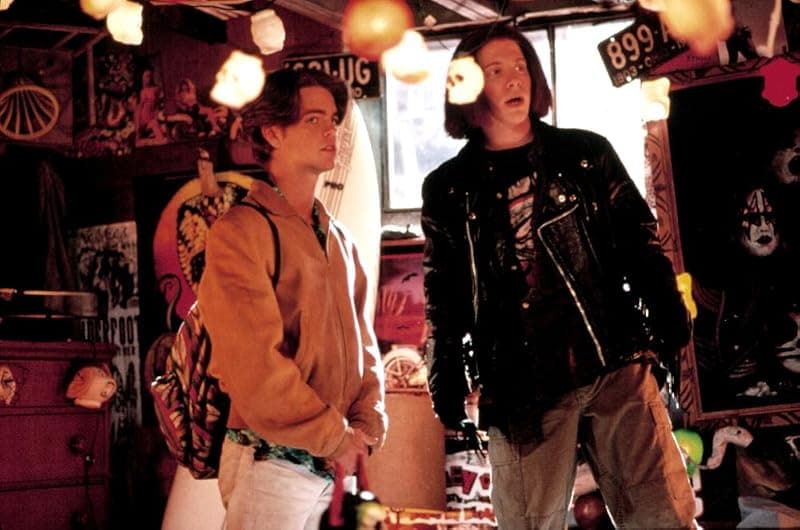
Shane McDermott as Mitchell Goosen with Seth Green as Wiley Messner—a pairing that anchors the film’s fish-out-of-water comedy.
Film frame via IMDb · Airborne (1993) © applicable rights holder ↗The ensemble
Working with the cast
McDermott spoke most expansively about Seth Green. Mitchell and Wiley share so much of the movie that the actors spent far more time together than McDermott did with most of the ensemble. He remembered Green as exceptionally funny, talented, and professional—someone who could make strangers smile in a restaurant or hotel lobby just by being himself. They became friends after filming, and Green helped McDermott get to know Los Angeles when he returned for additional work.
That ease lives inside the movie. Wiley panics, talks, tries on clothes, and ricochets through problems; Mitchell watches him with the patient amusement of somebody who has already decided they are family. McDermott later noted that fans still mention the clothing montage, proof that the film’s staying power is not limited to its biggest skating set pieces.
His time with Jack Black was more limited because of the production schedule, but Black’s creativity and talent were apparent immediately. With Brittney Powell, an early Mitchell-and-Nikki scene became an acting breakthrough. McDermott remembered finishing it, asking producer Steve McEveety how it had gone, and receiving a smile that told him he had found the character. From then on, he felt he knew who Mitchell was. The chemistry with Nikki benefits from that discovery: the confidence feels newly inhabited rather than mechanically performed.
The final descent
The Devil’s Backbone
The finale is where every version of Mitchell meets: the naturally gifted skater, the outsider who has finally built a team, and the peaceful kid who has found something worth risking a great deal of skin for. Professional skaters executed the most demanding action, Edwards doubled Mitchell, and McDermott participated where the production could use him safely. The result cuts performance and specialist work into one sustained rush.
McDermott’s “most carnage” recollection strips away any idea that his participation was ceremonial. Hills, speed, repeated takes, and pavement made the sequence physically punishing even with a first-rate stunt team. Yet his memories emphasize the pleasure of finally skating alongside the professionals. That enthusiasm is visible in Mitchell: the race is dangerous, but it is also the moment when he looks most completely alive.
The archive’s complete Devil’s Backbone guide → reconstructs the finale as ten probable screen-order segments rather than pretending the edit describes one continuous real-world route. From McDermott’s perspective, the geography may be fragmented; the experience was immediate enough to leave bruises.
Still proud
Airborne after Airborne
McDermott has never treated the movie as an embarrassing early credit. He told CityBeat it was the work of which he remained most proud, crediting a strong cast, an extraordinary production team, and an intangible spark that brought everything together. That affection is important. Fans are not preserving a movie its lead has spent decades trying to outrun; they are meeting him in the same place.
He has watched Airborne with nieces and nephews, who got the particular thrill of seeing their uncle on screen. For his fortieth birthday, he screened it at home for friends and family and enjoyed it with them. Those are wonderfully ordinary settings for a cult movie’s second life: not a premiere, but a television in a room full of people delighted to rewind somebody’s youth.
McDermott also understood how that afterlife happened. The theatrical release did not define the response. Years of repeat play on HBO and other television channels let viewers encounter the film, catch it again, memorize its moments, and hand it to somebody else. By the time people began seeking him out because of Mitchell, the movie had grown into its reputation through repetition. He knows the clothing montage, the skating, the airport arrival, and that name have lives of their own.
The long roll
Why Mitchell lasted
Mitchell remains aspirational because the movie never makes him unattainable. Kids wanted the hair, the loose layers, the surfboard, the Rollerblades, and especially the attitude—but the attitude was not built on money, power, or invulnerability. It was the confidence to stay recognizable when everybody around you insisted that fitting in required becoming harder.
He is an extremely specific early-1990s version of cool, preserved at the exact intersection of surfing, inline skating, alternative fashion, and earnest teen-movie romance. Specificity can date a character; here it gives him flavor. Mitchell is sincere in a way that would be easy to mock and difficult to fake. McDermott commits fully enough that the sincerity survives.
The film lets Mitchell skate, surf, fall in love, fight badly, make friends, and race down Cincinnati hills without turning him into a superhero. He falls. He misreads rooms. He needs Wiley and Nikki and eventually even the teammates who first reject him. McDermott keeps all of it on the same relaxed frequency. Three decades later, Mitchell Goosen still looks like somebody worth hanging out with—and, if the hill is not too steep, trying to follow.
Read more about the movie’s long afterlife in Why Airborne Still Has a Cult Following.
Read further
Sources
Primary records, interviews, established references, and clearly labeled specialist leads.
- AFI Catalog: Airborne ↗American Film Institute · Accessed 2026-09-11
Archival catalog record based in part on production notes and screen credits; used for cast, production, music, skating, locations, and release details.
- Airborne — Cast and Crew ↗Rotten Tomatoes · Accessed 2026-09-11
Used to corroborate principal actor and character credits.
- Revisiting a 2013 Interview with Airborne Star Shane McDermott ↗Cincinnati CityBeat · Accessed 2026-09-11
Direct interview: McDermott discusses filming at the airport, Pompilio’s, Krohn Conservatory, skating preparation, and stunt participation.
- HDTGM: A Conversation With Shane McDermott, Star of Airborne ↗Slashfilm · Accessed 2026-09-12
Direct interview covering McDermott’s casting, performance, production memories, and life away from day-to-day Hollywood work.