Wiley Messner / Cincinnati guide / Style apprentice
Seth
Green
Before the later fame, Green gave Airborne its anxious cousin, rapid-fire tour guide, fearless fashion experimenter, and funniest reminder that confidence rarely arrives all at once.
Wiley Messner wants to look like he has Cincinnati figured out. Seth Green makes every flicker of doubt visible—and turns the trying into the joke, the charm, and eventually the courage.
Meet the cousin
Playing Wiley Messner
Wiley is the first person Mitchell really gets in Cincinnati. He is family, roommate, school escort, warning system, and translator for a social order that seems obvious to everyone except the new kid. Where Mitchell arrives relaxed enough to treat the cold, the bullies, and the hockey crowd as temporary weather, Wiley knows every reason to worry. He can name the dangers because he has spent years arranging his life around them.
That anxiety makes him funny, but it does not reduce him to a joke. Wiley is observant. He understands who has power at school, who is likely to start trouble, and how badly a newcomer can misread the room. His warnings may sound frantic, yet they are often accurate. He is the audience surrogate who grasps the stakes before Mitchell does—and then has to stand beside someone who refuses to react with the expected fear.
Green also keeps a loyal streak visible beneath the nerves. Wiley is impressed by his cousin almost immediately, but the relationship is not just hero worship. He makes space for Mitchell in the Messner home, offers the local knowledge Mitchell lacks, and stays emotionally invested as the outsider’s problems become his own. By the end, Wiley is braver than the boy who first tried to explain why survival required keeping your head down. The change is modest enough to feel human.
Already a professional
Seth Green before Airborne
Airborne did not place an inexperienced performer beside a first-time feature lead and hope for chemistry. Green had been working professionally since childhood. By 1993, he already had years of film and television experience, including childhood work in Radio Days and the television adaptation of Stephen King’s It. The Television Academy’s career overview places those early roles well before the projects that later made him familiar to a much wider audience.
Green was still a teenager during the production, but he was not learning where the camera was. That experience shows in the precision of Wiley’s reactions. He knows when to crowd a line, when to let Mitchell’s stillness finish the joke, and when a look can carry more panic than another sentence. The performance feels spontaneous because the mechanics are controlled.
That context matters more than a checklist of later credits. Airborne catches a young actor who already understood pace and ensemble work, years before Austin Powers, Buffy the Vampire Slayer, Family Guy, and Robot Chicken would define different parts of his public career. Wiley is not a novelty rescued by hindsight. He works on his own terms; hindsight simply makes the confidence of the performance easier to appreciate.
Comic pressure
Why Wiley works
Green plays Wiley as someone continuously monitoring how he is being perceived. His posture can shrink when the hockey crowd appears, then expand the moment he thinks Mitchell’s reflected cool might cover him too. His face often gets to a conclusion before his words do. Alarm, admiration, embarrassment, and a fresh plan can pass through the same reaction shot.
The comedy comes from wanting, not stupidity. Wiley wants status, a less precarious place at school, a successful date, and some portion of Mitchell’s apparently effortless confidence. He is funny because he tries so hard to manage outcomes that Mitchell barely seems to notice. Green gives those attempts speed and specificity, while leaving enough vulnerability underneath that Wiley never feels pathetic.
He is not cruel enough to become the bitter sidekick and not helpless enough to become luggage for the hero. Wiley can be cautious, opportunistic, and deeply uncool, but Green plays each quality as a temporary defense rather than his entire personality. When confidence finally peeks through, it feels satisfying because we have watched him negotiate for every inch of it.
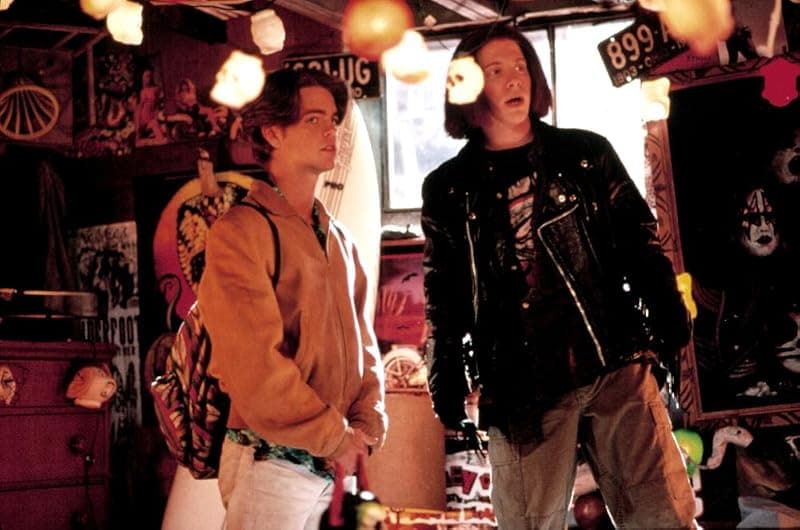
Seth Green as Wiley Messner with Shane McDermott as Mitchell Goosen. Wiley’s nervous momentum and Mitchell’s unhurried calm give Airborne its essential comic rhythm.
Film frame via IMDb · Airborne (1993) © applicable rights holder ↗Opposites in one room
Mitchell and Wiley
The cousin pairing saves Mitchell from becoming too effortlessly cool. On his own, the California newcomer could float above the story. Wiley gives that composure resistance. Every rushed explanation and worried glance makes Mitchell’s slower rhythm funnier, while Mitchell gives Wiley a person who does not treat his anxiety as a permanent social sentence.
Crucially, Mitchell never makes humiliating his awkward cousin the price of friendship. He accepts Wiley quickly. He may be amused by him, but he is not embarrassed to be seen with him, and he does not approach him as a makeover project. That generosity lets Wiley admire Mitchell without the relationship curdling into resentment. Mitchell’s confidence becomes something Wiley can borrow until he starts finding his own.
McDermott’s later recollections make the ease between them even more enjoyable. He said he spent more time with Green than with any other cast member because Mitchell and Wiley share so many scenes. In his 2017 interview, his summary was wonderfully simple: “Seth’s the best.” He remembered an experienced, funny, generous colleague who kept people laughing on set and later became a friend. The affection visible between the actors gives the cousins a warmth no amount of plot engineering could manufacture.
Closet sequence / Peak 1993
The clothing montage
Wiley trying on Mitchell’s clothes is one of those scenes fans can identify from a few seconds of movement. Right Said Fred’s “I’m Too Sexy” supplies the swagger while Green supplies everything the wardrobe cannot: poses, pivots, facial commitment, and the escalating conviction that one more outfit might finally solve the problem.
The montage is gloriously of its moment. Fabrics hang loose, patterns collide, and California style becomes a set of pieces Wiley can put on in front of a mirror. Green does not stand outside the sequence and mock it. He commits to each look as if this could genuinely be the one. That sincerity turns an obvious music cue into character comedy.
The deeper joke is gentle. Wiley wants Mitchell’s confidence but initially understands it as clothing. The scene lets him experiment with identity in the safest possible space, borrowing his cousin’s wardrobe before he can borrow his ease. McDermott later recalled that viewers still brought up the montage decades afterward. Of course they did: it compresses Wiley’s insecurity, hope, friendship, and physical comedy into pure early-1990s velocity. The song’s place in the film’s twelve-title credit list is documented in the archive’s soundtrack guide.
The Messner house
Wiley at home
The Messner household gives Wiley a different scale. At school, he is constantly measuring threats. At home, he is plainly somebody’s kid—living under parental rules, sharing space, and reacting to the sudden arrival of a cousin whose independence feels almost exotic. Aunt Irene and Uncle Louie keep the family scenes warm and grounded between the hockey confrontations and skating set pieces.
Mitchell brings a surfboard, unfamiliar habits, and a calm that seems impossible to Wiley. Their shared domestic space accelerates the friendship. Wiley does not have to arrange a formal invitation into Mitchell’s world; it has landed in his bedroom. He can question it, imitate it, and gradually trust it. The clothing montage works because the house has already become a place where he is safe enough to experiment.
Those scenes also give the movie breathing room. Wiley feels believable not only as a comic sidekick but as a teenager whose social fear does not disappear when the school day ends. Mitchell’s presence changes the temperature of the house without turning it into a fantasy clubhouse. The family connection gives the outsider a foothold in Cincinnati, and gives Wiley somebody close enough to disrupt his routines.
Know the hierarchy
Wiley at school
Wiley enters school scenes already knowing where he stands. Jack and the hockey crowd occupy the dangerous end of the social map; Wiley expects their attention to be bad news and warns Mitchell accordingly. The warnings establish the hierarchy for the audience, but they also reveal how thoroughly Wiley has internalized it. His first instinct is not to challenge the system. It is to navigate around the people who can make a day worse.
Mitchell’s arrival changes that experience because the usual intimidation fails to produce the usual response. Wiley suddenly has a front-row seat to someone meeting the same hierarchy without granting it absolute authority. Green’s reactions make that disruption legible: concern gives way to disbelief, then admiration, then the dangerous possibility that Wiley might participate instead of merely observe.
The movie does not turn him into a fearless new person overnight, and it is better for that. Wiley remains Wiley. He still calculates, worries, and talks faster when pressure rises. What changes is his willingness to stay in the scene. Courage here is not the disappearance of anxiety. It is the anxious kid deciding that loyalty matters more.
Timing is character
Seth’s comedy
Green’s comic instincts are clearest in transitions. He can snap from confidence to alarm without losing the thought that connects them. He lands lines quickly but does not rush past the audience’s chance to register Wiley’s latest humiliation. His physical comedy is elastic rather than chaotic: the body follows the character’s desperate attempt to look composed, then betrays it.
Fans familiar with his later work can recognize the speed and precision here without turning Wiley into a prediction of everything that followed. Green already knows how to support a scene from beside the protagonist, stealing attention for a reaction and then returning the rhythm to McDermott. Wiley is memorable because the performance is generous enough to make the partnership work.
Before the later fame
A snapshot, not a novelty
Rewatching Airborne now carries an unavoidable extra pleasure: Green became far more widely known, and Jack Black appears in an early supporting role. The temptation is to reduce the movie to a game of spotting future celebrities. Wiley deserves better. Green is not valuable here because audiences would recognize him later; later recognition helps audiences notice how much value he was already adding.
The performance feels like a clean snapshot of a young actor comfortable with the camera, secure enough to look insecure, and capable of shaping an ensemble from the second position. That makes the movie rewarding to revisit, but it does not make Wiley merely a historical curiosity. He remains one of the reasons the movie itself moves.
Wheels together
Wiley in the finale
By the later movement of the story, Wiley is no longer stationed safely outside the action explaining why everything is a bad idea. The group has changed. Mitchell’s arrival has altered the relationships around him, and Wiley belongs inside the camaraderie that follows. His participation matters less as an athletic claim than as a character payoff: the observer has become part of the team.
The film’s professional skating work belongs to Team Rollerblade and the documented stunt team, explored in the archive’s skating guide. Wiley’s contribution is emotional continuity. He connects the nervous first days in Cincinnati to the collective momentum of the finale. When the movie heads toward the Devil’s Backbone, it is no longer simply Mitchell against a hostile city. It is a group moving together.
Still trying / Still loyal
Why Wiley lasted
Most viewers probably knew a Wiley, or spent some part of adolescence feeling like one. He wants entry into a cooler world but has not learned how to stop announcing how badly he wants it. He is vulnerable, quotable, easily rattled, and funny without realizing exactly why. Green never treats any of that as permission to discard him.
His clothes are pure 1993. His reactions operate at cartoon speed. Yet the emotional engine is timeless: the fear that everybody else received the instructions for being cool and yours were lost in the mail. Wiley tries on a new identity, survives embarrassment, and discovers that belonging comes less from performing confidence than from showing up for people.
Mitchell may be the kid viewers wanted to become, but Wiley is often the kid they recognized. He gives the movie comic friction, a family center, and a friendship with something at stake. Seth Green plays him as a full person who happens to be extremely funny—and that is why, long after the outfits stopped looking remotely current, Wiley never did.
Keep rolling with Why Airborne Still Has a Cult Following.
Read further
Sources
Primary records, interviews, established references, and clearly labeled specialist leads.
- AFI Catalog: Airborne ↗American Film Institute · Accessed 2026-09-11
Archival catalog record based in part on production notes and screen credits; used for cast, production, music, skating, locations, and release details.
- Airborne — Cast and Crew ↗Rotten Tomatoes · Accessed 2026-09-11
Used to corroborate principal actor and character credits.
- Revisiting a 2013 Interview with Airborne Star Shane McDermott ↗Cincinnati CityBeat · Accessed 2026-09-11
Direct interview: McDermott discusses filming at the airport, Pompilio’s, Krohn Conservatory, skating preparation, and stunt participation.
- HDTGM: A Conversation With Shane McDermott, Star of Airborne ↗Slashfilm · Accessed 2026-09-12
Direct interview covering McDermott’s casting, performance, production memories, and life away from day-to-day Hollywood work.
- Seth Green — Biography ↗Television Academy · Accessed 2026-09-14
Institutional career overview used only to place Green’s child-acting work and later widely known roles in context.