Relive the 1993 rollerblading cult classic
Relive
Airborne
Surfing, skating, Cincinnati, romance, hockey, bullies, Pepe the shark, bean burritos, and one enormous downhill race. Somehow, it all still fits.
First there is blue water and California light. Then Mitchell Goosen steps into an Ohio winter dressed for another coast—and Airborne begins the glorious work of making Cincinnati feel like the center of the universe.
California, for a minute
Meet Mitchell Goosen
Mitchell begins the movie in the place that seems to explain everything about him. Southern California has given him surfing, sun, Rollerblades, loose clothes, long hair, and a way of moving through the world without looking hurried. He is confident, but not in the chest-out way the Cincinnati hockey players will understand. His confidence is quieter. He expects most problems to pass if he keeps his balance.
Then his parents leave for a zoology assignment in Australia, and Mitchell is sent to relatives in Cincinnati. For almost anybody else, that would simply be the premise. For Mitchell it is a total disruption of climate, landscape, wardrobe, and social language. The kid who understands waves lands in snow. The skater who treats movement as freedom walks into a school where athletic ability is tied to toughness, rank, and the willingness to throw a punch.
What makes Mitchell last in fan memory is that he never becomes a different person to solve the movie. He adjusts, certainly. He gets angry, gets hurt, makes mistakes, falls for Nikki, and learns that being calm does not mean avoiding every confrontation. But Shane McDermott keeps the California ease alive underneath it all. Mitchell wins people over more often than he defeats them, which is a much rarer kind of teen-movie cool.
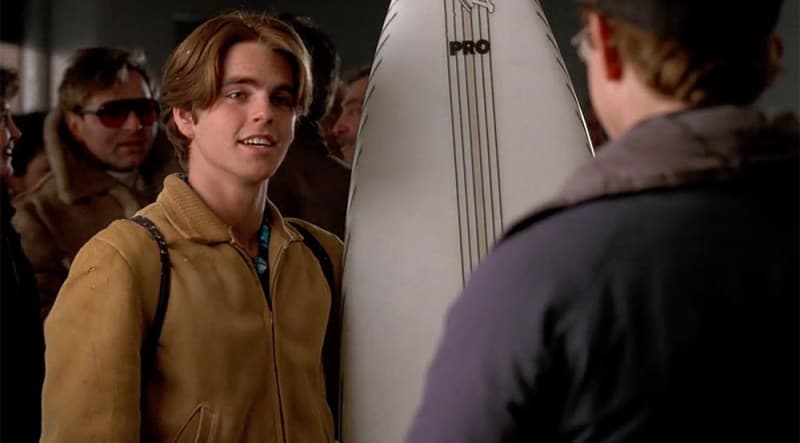
Mitchell’s arrival establishes the California-to-Cincinnati premise; independent location research identifies the terminal as Cincinnati/Northern Kentucky International Airport.
Film frame via Film Oblivion · Airborne (1993) © applicable rights holder ↗The temperature drops
From California to Cincinnati
The move works because the film makes it physical. Mitchell does not just tell us that Cincinnati is different. He arrives at CVG Airport with a surfboard, California clothes, and snow gathering around him. The image is funny, but it also contains the whole movie: Mitchell carrying one identity into a place that appears to have no use for it.
Aunt Irene and Uncle Louie give him a home. Wiley gives him a guide, even if the guide is anxious about nearly everything. Outside their house waits a city of brick schools, neighborhood streets, river edges, old buildings, steep grades, and winter skies. The geography is specific enough that Cincinnati never feels like a label pasted onto a generic teen story. By the end, its hills are not merely where Mitchell lives. They are the shape of the climax.
AFI records principal photography across Cincinnati, Kentucky, and Southern California during winter 1992. An Ohio blizzard supplied enough snow that a contemplated move to Minnesota for exterior work was abandoned. Western Hills High School hosted weekend classroom filming with student background actors; the company also spent five days in Kentucky before moving west. Those facts explain why the regional texture feels so dense. The movie did not borrow one skyline shot and retreat to a backlot. It moved through the place.
Follow the location archive or take the full tour in Where Was Airborne Filmed?
Cousins, immediately
Wiley worries enough for both of them
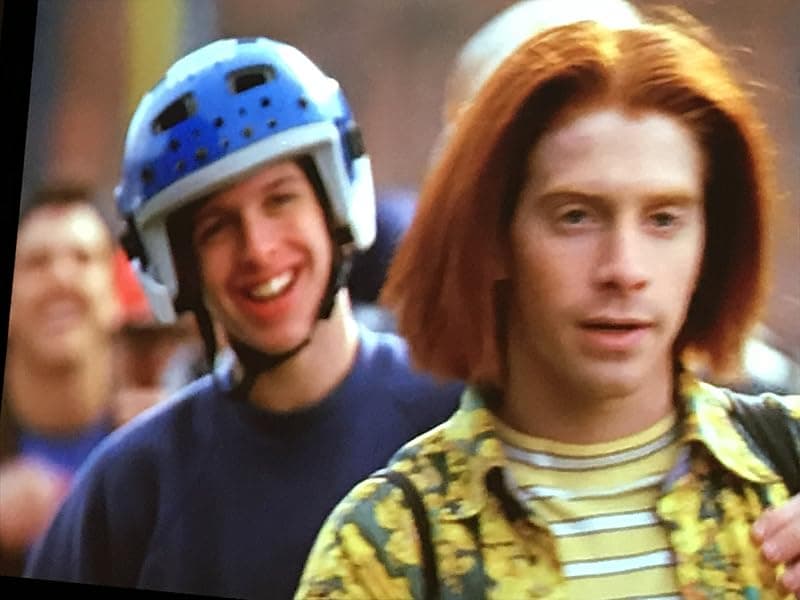
Wiley Messner understands Cincinnati’s school hierarchy before Mitchell has learned where to stand. He knows who is dangerous, what not to say, how badly things can go, and why a new kid dressed like Mitchell is about to attract attention. Seth Green makes the warnings come at comic speed. Wiley is a tour guide whose main attraction is everything that could ruin your day.
Mitchell’s response is one of the sweetest things in the movie: he accepts Wiley almost instantly. There is no makeover requirement for friendship, even when Mitchell’s wardrobe becomes available for experimentation. The clothing montage—Wiley trying on version after version of Mitchell’s loose, bright confidence to “I’m Too Sexy”—is funny because the clothes cannot do the emotional work for him. He wants the look before he has the ease.
That difference gives the cousins their rhythm. Mitchell slows a room down; Wiley speeds it up. Mitchell assumes a path will appear; Wiley has already imagined the five ways it might collapse. Yet Wiley is not only comic panic. The movie gradually lets him become braver without turning him into Mitchell. Green makes every little attempt count, and the friendship gives Airborne its warmest center.
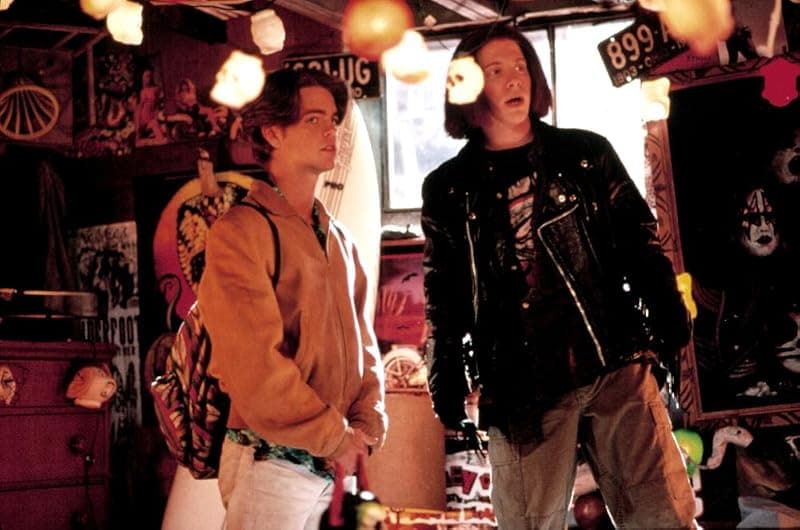
Mitchell and Wiley are opposites in tempo, not affection. Their immediate cousin chemistry gives Airborne its comic and emotional center.
Film frame via IMDb · Airborne (1993) © applicable rights holder ↗The movie slows down
Nikki changes the rhythm
Nikki is introduced inside the same school world that makes Mitchell an outsider, but the movie does not leave her there as a prize to be won from Jack. Brittney Powell gives her watchfulness, warmth, and the sense that she can see through performances of cool. That matters when everyone around Mitchell is busy deciding what his clothes, voice, and refusal to fight must mean.
The quieter Mitchell-and-Nikki scenes allow another version of Cincinnati to appear. The double date at Pompilio’s and the visit to Krohn Conservatory exchange locker rooms and hockey tension for restaurant light, glass, greenery, and awkward conversation. Mitchell can still turn a beautiful indoor setting into an excuse to move on skates, but the pace softens. He is no longer only reacting to the city. He is starting to enjoy being inside it.
The romance belongs in the movie because it reveals the gentleness underneath Mitchell’s confidence. He speaks plainly to Nikki, listens, and does not need every exchange to become a contest. Powell meets that tone without letting Nikki disappear into it. Their chemistry makes the action feel as if it has something human to return to once the wheels stop.
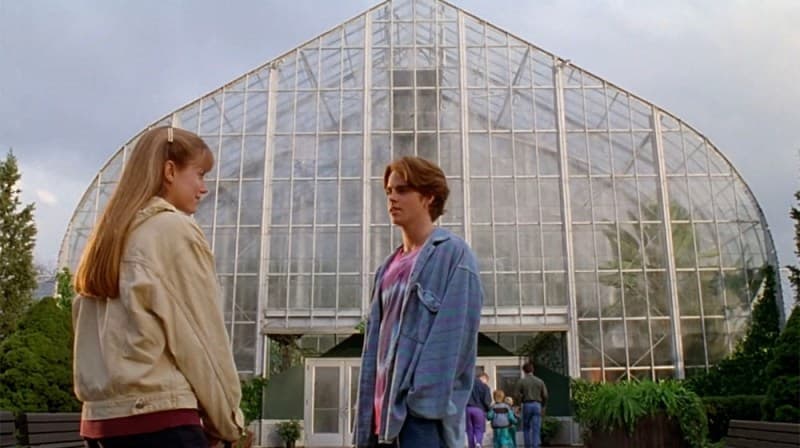
Nikki and Mitchell outside Krohn Conservatory, whose distinctive glasshouse makes this one of the film’s clearest Cincinnati location matches.
Film frame via Film Oblivion · Airborne (1993) © applicable rights holder ↗The established order
Jack, Augie, Snake, and the school world
Mitchell walks into a social system that existed long before he did. Jack stands at its center: a hockey player with status, anger, and a connection to Nikki that makes Mitchell’s arrival feel personal. Chris Conrad gives him more than generic bully menace. Jack is territorial, proud, and accustomed to a world in which aggression is understood as authority.
The group around him makes that authority visible. Augie adds physical and comic energy, a familiar face now but a supporting member of the crew in 1993. Snake supplies a sharper edge. Together with the wider hockey crowd, they create the feeling that Mitchell has not simply annoyed one boy; he has stepped into a network of teammates, loyalties, jokes, and grudges.
The movie eventually allows that network to change. Ability earns attention, shared stakes redraw alliances, and former antagonists become something more complicated than enemies. They are not flattened into instant best friends. They remain loud, competitive teenagers who gradually discover that Mitchell’s way of moving through the world has value.
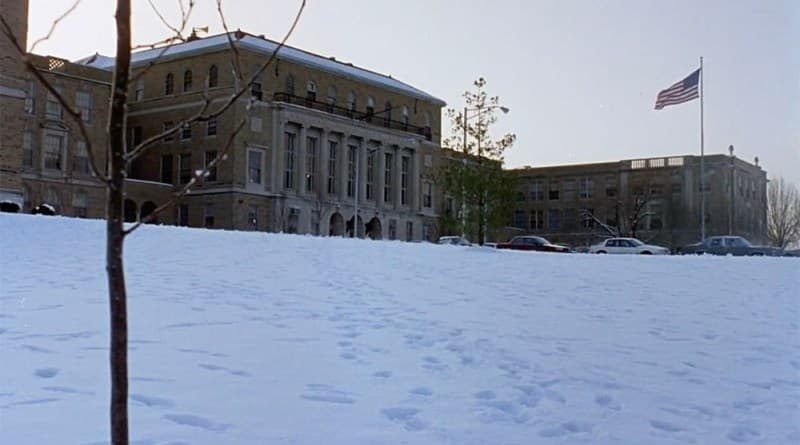
The school exterior in the film. AFI records Western Hills High School as a production location used for weekend filming with student background actors.
Film frame via Film Oblivion · Airborne (1993) © applicable rights holder ↗Ice, pavement, pressure
The hockey conflict tests the calm
Hockey gives Cincinnati’s social order a physical language. Jack expects toughness to look like confrontation: take the hit, return it harder, prove you belong. Mitchell’s athletic ability is obvious, but his refusal to perform anger on command is read as weakness. The conflict tightens because both boys understand confidence differently.
Mitchell’s skating style is fluid, individual, and improvisational. Hockey asks him to operate inside a team, hold territory, and absorb contact. The scenes work not because the movie suddenly becomes a serious sports drama, but because they put his philosophy under pressure. Being laid-back is easy in California sunlight. It is harder when somebody is shoving you, humiliating your cousin, or insisting that restraint means fear.
Eventually Mitchell’s calm cracks. That is important too. The movie does not treat him as a surfer saint floating above ordinary anger. He has limits, and Cincinnati finds them. What matters is that the fight does not become his final definition. The story keeps moving toward a test where balance, nerve, teamwork, and the ability to choose a line down the hill matter more than who can look hardest in a hallway.
1993, completely
The clothes, the hair, the attitude
Airborne does not merely take place in 1993. It arrives wearing 1993 in layers. Mitchell’s shirts hang loose, colors and patterns collide, sleeves collect under jackets, and his hair seems to preserve California sunlight even in the snow. Wiley approaches the wardrobe like a laboratory of possible selves. The hockey crew favors its own bulkier silhouette. Every group can be read before anyone speaks.
For younger viewers, Mitchell looked impossibly cool because the styling and the movement agreed. The clothes did not appear selected by an adult costume department to announce rebellion. They seemed built for rolling, leaning, sitting sideways, and treating every handrail or slope as a possibility. Add the surfer vocabulary, the unforced posture, and those Rollerblades, and the character offered a complete portable identity.
It is easy to revisit early-1990s fashion as a joke. The better pleasure is to let it work again. Wiley’s montage is affectionate, not cruel. His experiments are ridiculous because trying on confidence is always a little ridiculous. The movie knows style can help, knows it cannot finish the job, and still understands why a kid might want every piece Mitchell owns.
Turn it up
The soundtrack carries the decade
Music gives Airborne much of its emotional shorthand. The California opening needs lift. The skating needs propulsion. Wiley’s fashion show needs a joke everybody recognizes in a beat. The romance needs room to breathe. Stewart Copeland’s credited music and the film’s twelve cataloged songs keep those modes connected even when the story jumps from family comedy to hockey tension to downhill action.
The end credits range widely: Roger Waters, Right Said Fred, Ugly Kid Joe, Diesel, Jeremy Jordan, Marc Bonilla, BulletBoys, and others all belong to the record. “I’m Too Sexy” is inseparable from Wiley trying to dress his way into Mitchell’s confidence. Tracks such as Jeremy Jordan’s “My Love Is Good Enough,” Diesel’s “Never Miss Your Water” and “Tip of My Tongue,” Marc Bonilla’s “Afterburner,” and Ugly Kid Joe’s “Busy Bee” contribute to a soundtrack identity that feels less curated into one genre than joyfully caught in its moment.
No commercially released Airborne soundtrack album has been confirmed by the archive, which only makes the music feel more tied to the movie itself. Fans remember songs through scenes, VHS playback, and the work of tracking them down elsewhere. The complete soundtrack guide separates the verified credit list from uncertain scene placements—and may send a few of those hooks directly back into your head.
Wheels make the difference
Skating is the movie’s secret weapon
Plenty of teen movies can move a new kid into a hostile school. Airborne becomes itself when Mitchell starts rolling. Skating turns his personality into motion: relaxed but alert, graceful without being delicate, always looking for a line that other people have missed. It also transforms Cincinnati. Stairs, parking lots, overpasses, and hills stop being background and become invitations.
Shane McDermott brought genuine comfort on Rollerblades. He later recalled using them to travel to auditions in New York and said skating those streets taught him enough to make Mitchell look authentic. The largest action demanded specialists. AFI records that Team Rollerblade spent twelve days choreographing sequences, performing onscreen stunts, and training the actors. Pat Parnell coordinated the Rollerblade work, and Chris Edwards played Walt while serving as Mitchell’s skating double.
That combination is the key. McDermott can carry Mitchell’s physical ease through the connective moments; the professionals can push the set pieces into speed, danger, and spectacle. The edit lets character and craft flow together. You believe Mitchell is a skater before the movie asks you to believe he can lead anybody down the Devil’s Backbone.
The skating ensemble in motion. AFI documents Team Rollerblade’s work choreographing sequences, performing stunts, and training the actors.
Film frame via IMDb · Airborne (1993) © applicable rights holder ↗A city becomes a movie
Cincinnati becomes Airborne
The film’s locations do more than prove that a production visited Ohio. CVG gives Mitchell his first shock of winter. Western Hills High School supplies brick, hallways, classrooms, and the ordinary weight of a real school. Pompilio’s and Krohn Conservatory warm the date scenes. Newport and Bellevue extend the world across the river. Parking lots, steps, overpasses, and streets give the skating a rougher surface than a studio-built course could offer.
The region’s contradictions suit the movie: dense neighborhoods and broad river views, industrial edges and glasshouse greenery, flat pavement interrupted by hills that seem to drop out from under the skaters. Mitchell arrives with a California idea of movement, but Cincinnati gives that movement resistance. Snow, hockey, traffic, brick, and elevation make him adapt.
By the finale, the city has become inseparable from the title. Airborne may begin by asking whether a California kid can survive Cincinnati. It ends by showing what happens when his skating imagination meets the city’s terrain. The locations are not an obstacle the movie overcomes; they are its visual identity.
Two movies in balance
Quiet Airborne and loud Airborne
The loud version is easy to remember: blades on pavement, bodies against boards, school confrontations, comic panic, and a downhill race cut for maximum velocity. But Airborne would be exhausting if it stayed at that volume. Its heart accumulates in the pauses—the Messner family taking Mitchell in, Wiley admitting fear without quite meaning to, Nikki and Mitchell talking when nobody needs to win, a California kid looking at a city that is slowly becoming home.
The tones should not fit as comfortably as they do. A shark named Pepe shares a movie with first love. Bean burritos sit beside hockey bruises. Broad comedy gives way to sincere advice, then Stewart Copeland’s music and a licensed track carry everyone back into motion. The film never seems embarrassed by the mixture. That lack of embarrassment is part of its charm.
Quiet Airborne makes loud Airborne matter. We care about the race because Mitchell and Wiley have become a team before the starting line. We care about Nikki watching because the romance has been allowed to breathe. We care when former rivals skate together because the school conflict had enough time to feel personal. The spectacle is the release; the smaller scenes built the pressure.
The hill everyone remembers
The Devil’s Backbone
Everything in the movie points downhill. Mitchell’s skating has earned respect. Rivalries have shifted. Wiley has spent the story trying to borrow courage and now has to find his own. The crew gathers above a course whose name sounds like a dare children would repeat until it became local legend. Then gravity takes over.
The Devil’s Backbone works because it feels too large for the movie that came before it—in the best possible way. Skaters pour through streets, attack stairs, duck obstacles, crowd one another, fall, recover, and keep accelerating. The sequence cuts between locations across Cincinnati and Northern Kentucky, turning separate hills and urban fragments into one impossible continuous descent. We do not experience a map. We experience momentum.
The danger has texture. Pavement is close. Corners arrive quickly. Professional skating and stunt work give the speed credibility, while the character beats keep the race from becoming a demonstration reel. Mitchell is still Mitchell in motion; Wiley’s struggle still matters; the team forged out of former enemies has to hold together. Every earlier argument about toughness is answered by the nerve required to commit to the hill.
For many viewers, this is the sequence that escaped the movie and entered childhood imagination. Any slope could become a starting line. Any neighborhood could hide its own Backbone. The actual screen route is an editorial construction, but the feeling is beautifully direct: look down, push off, and trust that balance will arrive before the bottom.
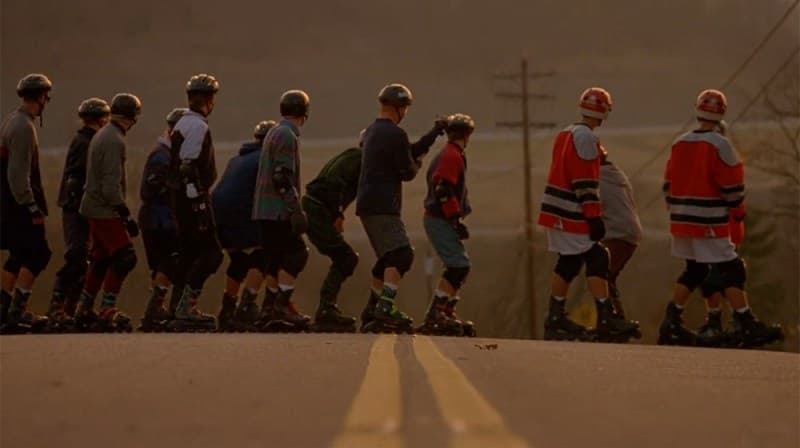
The crews gather before the Devil’s Backbone, where character, professional skating, Cincinnati terrain, and pure momentum finally meet.
Film frame via Film Oblivion · Airborne (1993) © applicable rights holder ↗Under all that style
What Airborne is really about
Nobody needs to pretend Airborne is Shakespeare to find something durable inside it. The movie understands the particular loneliness of arriving somewhere new and being told, directly or otherwise, that survival depends on becoming less recognizable. Mitchell is expected to dress differently, speak differently, fight differently, and accept the local definition of toughness.
He changes without surrendering. That is the important distinction. He learns the city, joins the hockey world, lets people matter to him, and discovers that calm cannot solve every problem. But he does not become cruel to prove he is confident. He does not discard Wiley once cooler company becomes available. He does not treat Nikki as a trophy. He remains Mitchell, only more connected.
The movie also knows the difference between being cool and trying to look cool. Mitchell’s style works because he inhabits it. Wiley’s montage is charming because he has not reached that ease yet. Jack’s authority looks powerful until it depends too heavily on everybody else recognizing it. By the end, belonging is not a prize Mitchell takes from the group. It is something the characters build by allowing one another to be more than the roles they started with.
The parking-lot afterlife
Why kids wanted Rollerblades
The most immediate response to Airborne was not analysis. It was wanting skates. Mitchell made ordinary pavement look newly available. A driveway could become practice. A handrail could become a terrible idea. The largest hill nearby could be given a dramatic name, even if sensible parents had absolutely no intention of letting anyone race down it.
The impulse behind this archive began that way: seeing the movie at ten in Southern California, wanting Rollerblades immediately, copying what could be copied of Mitchell’s style, and imagining a hometown Devil’s Backbone. The details are personal; the reaction is not. The film reached a lot of viewers at exactly the age when a movie could alter the equipment they wanted and the possibilities they saw outside.
That is why the skating remains more than dated extreme-sports packaging. Airborne did not only show people a sport. It made movement look like personality, independence, and friendship at once. You could roll out the door as yourself and return, at least in imagination, a little more like Mitchell Goosen.
Everybody in the frame
The cast in hindsight
The ensemble has become more interesting with time, but not merely because several actors grew famous. McDermott and Powell remain indelibly Mitchell and Nikki. Green gives Wiley a comic rhythm all his own. Conrad, Jack Black, Alanna Ubach, and Vargas make the school world crowded with distinct personalities. Edie McClurg and Patrick O’Brien give the Messner home warmth and eccentricity. Edwards links the story cast directly to the skating craft.
Later careers add recognition, especially when a young Black suddenly appears in the group, but the real pleasure is how well everyone belongs to this movie. They look like people sharing the same cold hallways, hotel downtime, hockey rink, and strange production adventure. Airborne did not assemble a future-star showcase. It assembled a memorable teen ensemble, and time made the intersections more visible.
Rewind, return, repeat
How people kept finding it
The September 1993 theatrical release was only the beginning of the relationship fans would have with Airborne. Home video made the movie repeatable. A probable March 16, 1994 North American Warner VHS date sits alongside documented European VHS editions and a probable 1994 U.S. LaserDisc. The Warner Archive DVD followed in 2009, and a U.S. digital listing was verified in 2026.
Shane McDermott has pointed to repeat television exposure, including HBO, as a major part of the film’s second life. That path fits the way people remember it: caught midway through, found at a rental store, recorded, rewound, quoted, then shown to a friend. The movie became intimate through repetition. The clothing montage, Pepe, the conservatory, and the starting line could become familiar long before anyone knew the names of the filming locations.
VHS is part of this site’s visual language because it suits the movie’s afterlife. Airborne became the sort of object that waited on a shelf until somebody wanted the feeling again. Tracking editions matters, but the deeper story is simple: people kept pressing play.
Still rolling
Still rolling after all these years.
Airborne was never required to become the defining movie of 1993. It only had to reach the right people with the right combination: Mitchell’s impossible calm, Wiley’s panic, Nikki’s warmth, Cincinnati snow, loose clothes, loud songs, Rollerblades, and a hill that looked like it might continue forever.
Decades later, the mixture remains wonderfully specific. You can laugh at the bean burritos, feel the date scenes settle into a quieter rhythm, notice a future-famous face in the hockey crowd, and still feel the Devil’s Backbone pull the whole movie forward. Sincerity keeps it from becoming a museum piece. The film loves skating, friendship, romance, style, and the possibility that confidence can be kind. It never apologizes for any of them.
That is why reliving it feels better than merely remembering it. Mitchell is still stepping into the snow. Wiley is still trying on the clothes. Nikki is still waiting outside the conservatory. The crews are still gathering at the top of the hill. Somewhere, the tape has just finished rewinding.
Read further
Sources
Primary records, interviews, established references, and clearly labeled specialist leads.
- AFI Catalog: Airborne ↗American Film Institute · Accessed 2026-09-11
Archival catalog record based in part on production notes and screen credits; used for cast, production, music, skating, locations, and release details.
- Airborne — Home media ↗Moviepedia / Fandom · Accessed 2026-09-12
Community-maintained catalog lead for the March 16, 1994 North American VHS date. The date remains probable pending a Warner catalog or original carrier.
- Airborne — Company credits ↗IMDb · Accessed 2026-09-11
Distributor listing used for the documented 1994 German VHS release and Warner Home Video distribution.
- Airborne LaserDisc catalog entry ↗Pink Floyd DVD Discography appendix · Accessed 2026-09-11
Format-specialist catalog records Warner Home Video 12981, barcode 0 85391 298168, and a 1994 U.S. release; an original Warner catalog remains desirable.
- Airborne DVD — Warner Archive Collection ↗Blu-ray.com · Accessed 2026-09-11
Catalog entry identifies the Region 1 Warner Archive DVD and September 15, 2009 release date.
- Airborne — Movies on Google Play ↗Google Play · Accessed 2026-09-11
First-party storefront record confirms U.S. digital rental and purchase availability when accessed; availability can change.
- Airborne — Cast and Crew ↗Rotten Tomatoes · Accessed 2026-09-11
Used to corroborate principal actor and character credits.
- Revisiting a 2013 Interview with Airborne Star Shane McDermott ↗Cincinnati CityBeat · Accessed 2026-09-11
Direct interview: McDermott discusses filming at the airport, Pompilio’s, Krohn Conservatory, skating preparation, and stunt participation.
- HDTGM: A Conversation With Shane McDermott, Star of Airborne ↗Slashfilm · Accessed 2026-09-12
Direct interview covering McDermott’s casting, performance, production memories, and life away from day-to-day Hollywood work.
- KRS Blade Brand ↗KRS Blade Brand · Accessed 2026-09-12
Chris Edwards’ site describes his continuing connection to rollerblading through KRS Blade Brand. Included as context, not an endorsement.
- Filming Locations — Airborne (1993) ↗Film Oblivion · Accessed 2026-09-11
Specialist location comparison used as a lead and corroborating source; exact sites remain probable unless independently confirmed.
- Movies Filmed in Cincinnati Parks ↗Cincinnati Parks · Accessed 2026-09-11
Municipal parks department identifies Airborne filming at Krohn Conservatory.
- Movie-Filming Locations in Northern Kentucky and the Cincy Region ↗Visit Cincy · Accessed 2026-09-11
Regional tourism bureau identifies the film with Krohn Conservatory and Wiley’s Linden Avenue setting in Newport.
- Airborne — Filming & production ↗IMDb · Accessed 2026-09-11
Established database used as corroboration for named production locations, not as sole evidence for precise scene matching.
- Airborne (1993) ↗FilmMusic.com · Accessed 2026-09-11
The specialist catalog lists Stewart Copeland as composer and reports no soundtrack album in its database. This supports a conservative 'not confirmed' conclusion, not proof that no release ever existed.
- Amused to Death — release record ↗MusicBrainz · Accessed 2026-09-11
Catalog record used for the 1992 Columbia album context.
- Try My Love — Jeremy Jordan ↗AllMusic · Accessed 2026-09-11
Album record used to corroborate the two Jeremy Jordan tracks and Giant Records context.
- Hepfidelity — Diesel ↗Apple Music · Accessed 2026-09-11
Label storefront record used to corroborate the Diesel album and track context.
- EE Ticket — disc record ↗MusicBrainz · Accessed 2026-09-11
Catalog record used for Marc Bonilla’s 1991 album context.
- I’m Too Sexy — single record ↗MusicBrainz · Accessed 2026-09-11
Catalog record used for the 1991 single context.
- America’s Least Wanted — release group ↗MusicBrainz · Accessed 2026-09-11
Catalog record used for the 1992 album context.
- Za-Za — release record ↗MusicBrainz · Accessed 2026-09-11
Catalog record used for the 1993 Warner Bros. album context.